Chinese Plates fit for an Acehnese Queen
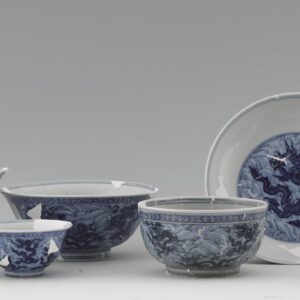
All over Southeast Asia is found a particular type of coarse Chinese export porcelain traditionally known as ‘Swatow’ (now more accurately termed Zhangzhou) ware, dating from the late Ming period.
One characteristic type of large Swatow dish had a central circle with eight smaller circles around it, all filled with inscriptions in Arabic script. These plates bore a marked visual similarity with the design of the seal of the sultans of Aceh in north Sumatra, which by the early 17th century was the greatest Islamic kingdom in Southeast Asia.
For a period of 250 years the great seal of Aceh always gave the name of the reigning sovereign in a central circle, surrounded by eight small circles containing the names of illustrious forebears. This visual congruence gave rise to a popular tradition within Indonesia that the Swatow calligraphic plates were specially ordered from China by the rulers of Aceh in the shape of their seal. However, chronological scrutiny belies this widely-held belief, as the Swatow plates were largely produced before the Acehnese ‘Ninefold Seal’was created in the mid 17th century, most likely in the reign of Sultanah Tajul Alam Safiatuddin Syah (r. 1641-1675).
This lecture is kindly sponsored by Shirley Mueller
Speaker
-
 Annabel Teh GallopLead Curator, Southeast Asia, The British Library
Dr Annabel Teh Gallop is head of the Southeast Asia section at the British Library in London. Her main research interests are in Malay manuscripts, letters, documents and seals, and the art of the Qur’an across the Indian Ocean world.
Recent publications include Malay seals from the Islamic world of Southeast Asia (2019), a catalogue of over 2,000 seals from Southeast Asia inscribed in Arabic script.
She was elected a Fellow of the British Academy in 2019.