Connecting Empires: The Belitung Shipwreck and Maritime Trade in ninth century Asia
Sometime in the middle of the ninth century, a ship set sail on a voyage that would take it from the Persian Gulf to the Pacific Ocean. It was a journey that connected two empires, the Abbasid Caliphate (in modern-day Iran and Iraq) and Tang dynasty China, as well as many different cultures in India and Southeast Asia along the way. Upon reaching China, the ship would have unloaded and sold its cargo, the contents of which remain unknown to us. The ship then assembled a cargo for the return voyage, the vast bulk of which consisted of Chinese ceramics made in the kilns at Changsha. Over 60,000 such bowls were acquired and carefully packed in large storage jars. Alongside this mass cargo, ceramics of higher quality were also procured as well as precious metals such as gold and silver. Laden with this high value cargo, the ship cast off on its journey home. However, while sailing through Southeast Asian waters, disaster struck. The vessel sank in the Java Sea and was lost to the vicissitudes of history. There it lay until it was discovered in 1998 by fishermen diving for sea cucumbers off the coast of Belitung Island. In many ways the Belitung Wreck (also known as the Tang Shipwreck) elucidates the complexity of globalization and interconnectivity in ninth century Asia.
This lecture is kindly sponsored by

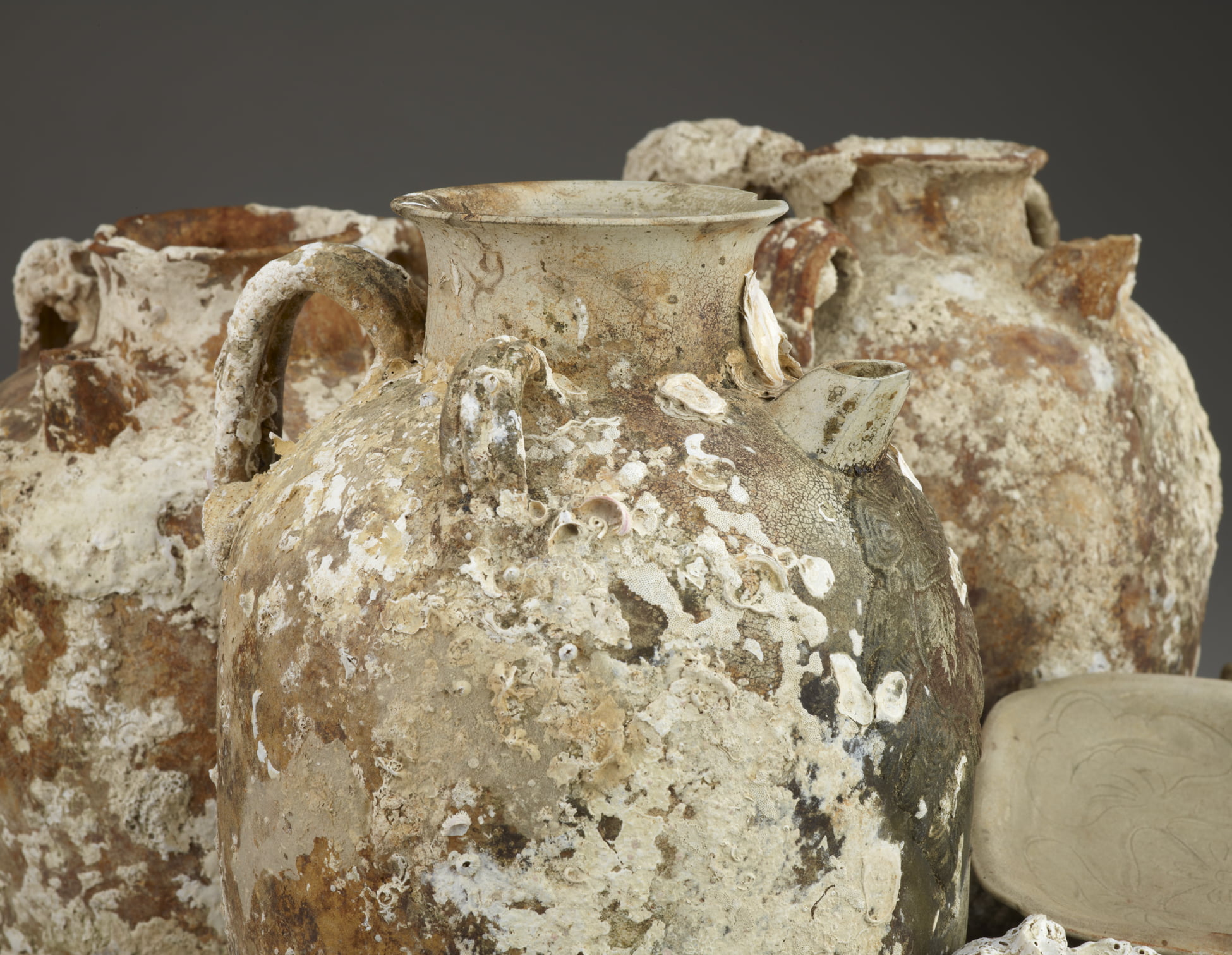
Image Caption: Changsha ewers recovered from the Belitung Wreck.
Courtesy of the Asian Civilisations Museum, Singapore.
Speaker
-
 Stephen MurphyPratapaditya Pal Senior Lecturer in Curating and Museology of Asian Art
Stephen A. Murphy is Pratapaditya Pal Senior Lecturer in Curating and Museology of Asian Art at SOAS, University of London. Prior to this he was Senior Curator for Southeast Asia and curator-in-charge of the Tang Shipwreck Gallery at the Asian Civilisations Museum, Singapore. He holds a PhD from the Department of History of Art and Archaeology, SOAS. He specializes in the art and archaeology of early Buddhism and Hinduism in Southeast Asia with a focus on Thailand and Laos. He has a particular interest in the 7th to 9th centuries CE and looks at connections between Southeast Asian cultures and the wider world of Tang China, India and beyond. His museological focus engages with issues surrounding colonialism and repatriation with a particular focus on Thailand and has organized several exhibitions on Southeast Asia.
He is co-editor, with Alan Chong, of The Tang Shipwreck: Art and exchange in the 9th century (2017) and co-editor of Before Siam: Essays in Art and Archaeology, (River Books & The Siam Society, 2014). He has contributed papers to leading academic journals such as Asian Perspectives, The Journal of the Royal Asiatic Society and The Journal of Southeast Asian Studies. His forthcoming book, Buddhist Landscapes: Art and Archaeology of the Khorat Plateau, 7th to 11th Centuries to be published by SAAAP-NUS Series Art and Archaeology of Southeast Asia: Hindu-Buddhist Traditions, traces the outlines of Buddhism’s spread into Northeast Thailand and Central Laos.